
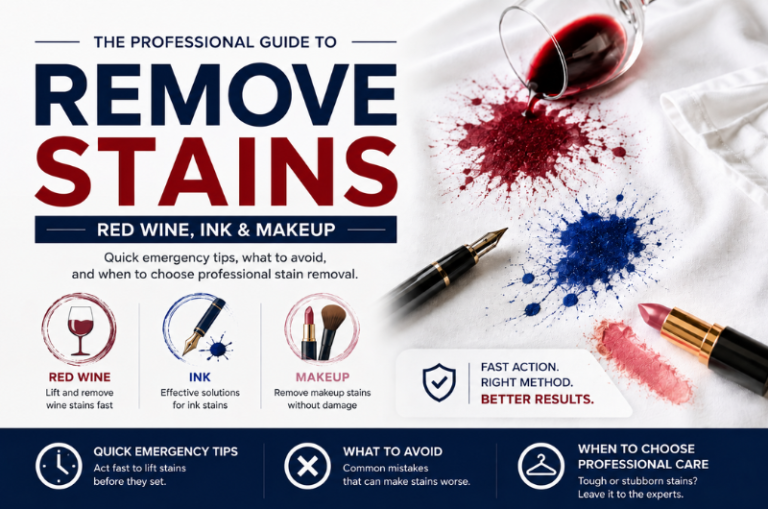
It always happens at the worst possible time. You’re at a dinner party and someone knocks a glass of red wine across your sleeve. You’re signing a form and the pen leaks across your shirt pocket. You lean in for a hug and walk away with a foundation smudge on your shoulder. Knowing how to remove stains quickly can make a major difference, because the first few minutes often determine whether a mark disappears or becomes much harder to treat.
This guide explains how to remove stains immediately after they happen, including how to remove red wine stains, the right approach to ink stain removal, and practical makeup stain removal tips. We’ll also explain emergency stain removal, what you should avoid doing, and when professional stain removal is the safer choice.
Looking for a deeper guide to treating stains once you’re home, especially on white or light-coloured garments? See our full guide to removing stains from white clothes.
Why the First Few Minutes Matter When You Need to Know How to Remove Stains
Fresh stains are generally easier to deal with because they have not had as much time to penetrate and bond with fabric fibres. Understanding how to remove stains immediately can therefore improve your chances of successful emergency stain removal.
Heat, rubbing and leaving a stain untreated can make the problem worse. Whether you’re dealing with wine, ink or makeup, the first response should be gentle and controlled.
The golden rules for emergency stain removal
- Act immediately rather than waiting until you get home.
- Blot the affected area instead of rubbing it.
- Work from the outside towards the centre of the stain.
- Avoid hot water unless you know it is suitable for the particular stain and fabric.
- Never use a hairdryer or iron over an untreated stain.
- Avoid applying several different products because this can make later professional stain removal more difficult.
- If you’re unsure how to remove stains from a particular fabric, stop treating it and seek professional advice.
These simple steps form the foundation of how to remove stains safely without accidentally spreading or setting them.
Our specialists provide reliable cleaning, repairs, and alterations. contact us and book today.
How to Remove Red Wine Stains: Emergency Steps
Red wine is one of the most common emergency stains, particularly at dinners, parties and events. Fortunately, knowing how to remove red wine stains quickly can prevent the mark from becoming more difficult to treat.
When you’re trying to work out how to remove red wine stains, focus first on removing as much liquid as possible without spreading it.
1. Blot the red wine immediately
Use a clean napkin, tissue or cloth to gently blot the affected area. Do not rub the fabric. Rubbing can push wine further into the fibres and make how to remove red wine stains much more difficult later.
2. Use plain sparkling water carefully
If you’re at a restaurant or event, ask for plain soda or sparkling water. Dab a small amount onto the stain and blot again rather than pouring a large quantity over the garment.
This can be useful as an initial emergency stain removal step while you’re still away from home.
3. Avoid excessive salt
Salt is often recommended as a quick solution for wine stains, but it should not be considered a guaranteed method for how to remove red wine stains. Adding too much product can leave residue and does not replace proper stain treatment.
4. Don’t rely on the white-wine trick
Using white wine to treat red wine is a popular household tip, but it is not a reliable method for how to remove red wine stains. Adding another liquid to the garment may create additional problems.
5. Avoid heat
Do not use hot water, a hairdryer or an iron while attempting how to remove red wine stains. Heat can make some stains much more difficult to remove.
If wine has reached silk, wool, velvet or a structured garment such as a blazer or formal dress, professional treatment is usually the safer option.
Ink Stain Removal: What to Do Immediately
Ink can be particularly challenging because different pens and inks can contain different ingredients. Effective ink stain removal depends on the type of ink, the fabric and how long the mark has been present.
If you need ink stain removal while you’re away from home, the most important thing is to prevent the ink from spreading.
1. Blot fresh ink
Use a dry, clean cloth or tissue to gently absorb wet ink. Avoid rubbing because this can spread the mark across a larger section of fabric.
Good ink stain removal starts with controlling the stain rather than trying to remove everything immediately.
2. Place absorbent material underneath
If possible, place a clean cloth or paper towel underneath the stained section. This can help prevent ink from transferring through the fabric to another layer.
3. Avoid experimenting with water
Water is not always the best first step for ink stain removal. Depending on the ink and material, adding water can spread the colour and make the stain more difficult to control.
4. Be careful with alcohol-based products
Hand sanitiser and other alcohol-based products are sometimes suggested for ink stain removal, but they should not be used blindly. Alcohol can affect dyes, finishes and delicate materials.
For silk, wool, coloured garments and valuable clothing, professional ink stain removal is often the better option.
5. Don’t keep adding products
Trying several home remedies one after another can make ink stain removal more complicated. If the first careful attempt does not work, stop and consider professional treatment.
Makeup Stain Removal: How to Deal With Foundation, Lipstick and Mascara
Makeup stains are another common clothing emergency. Foundation, lipstick, mascara and other cosmetics can contain oils, pigments and waxes, making makeup stain removal dependent on the type of product involved.
If you’re wondering how to remove stains caused by makeup, start by identifying whether the product is powder-based or liquid/oil-based.
1. Remove excess makeup first
Use a blunt edge, such as a spoon or the edge of a card, to gently lift excess makeup from the surface. This is an important first step in makeup stain removal because rubbing can push cosmetics deeper into the fabric.
2. Blot rather than rub
Use a clean, dry cloth to gently blot the affected area. Work from the outside towards the centre to control the spread.
This approach is useful for makeup stain removal when dealing with fresh foundation or other liquid cosmetics.
3. Be careful with oil-based makeup
Foundation and lipstick can contain oils. A tiny amount of mild washing-up liquid may sometimes help on suitable, washable fabrics, but always test an inconspicuous area first.
Avoid this approach on silk, wool or other delicate materials. Incorrect treatment can make makeup stain removal more difficult.
4. Brush away powder makeup
If the makeup is powder-based, gently remove the excess powder before introducing any liquid. Adding liquid too early can turn powder into a paste.
This simple step can make makeup stain removal easier and reduce the risk of spreading the cosmetic.
5. Avoid using makeup remover on clothing
Makeup remover and micellar water are designed for skin, not textiles. They can contain ingredients that leave residue or affect fabric colour.
When you’re unsure how to remove stains caused by cosmetics, it is safer to use minimal intervention rather than experimenting with skincare products.
How to Remove Stains Without Making Them Worse
Knowing how to remove stains is not just about knowing which product to use. It is equally important to understand which common mistakes can make a stain worse.
Don’t rub the stain
Rubbing can push the stain deeper into the fabric and spread it over a larger area. Gentle blotting is usually the safer first response for emergency stain removal.
Don’t apply heat
Heat can set certain stains into fibres. Avoid irons, tumble dryers, hairdryers and hot water until the stain has been properly assessed.
Don’t use multiple cleaning products
Combining different products can damage fabric or interfere with later professional stain removal. One of the most important rules for how to remove stains is to avoid unnecessary experimentation.
Don’t ignore the fabric type
The safest approach for cotton may be completely unsuitable for silk, wool, suede or leather. Fabric type should always be considered when deciding how to remove stains.
When Professional Stain Removal Is the Better Choice
Home treatment may be appropriate for small, fresh stains on sturdy everyday fabrics. However, professional stain removal is often the safest option when the garment is valuable, delicate or difficult to treat.
Consider professional stain removal when:
- The garment is made from silk, wool, cashmere, suede or leather.
- The clothing contains beading, sequins, embroidery or delicate trims.
- You have already tried a home treatment without success.
- The stain has dried or been present for a long time.
- The garment is expensive or sentimental.
- You are unsure what caused the stain.
- You don’t know how to remove stains without risking damage to the material.
- The garment is a wedding dress, formal suit or special occasion outfit.
Professional stain removal is particularly useful for ink because the correct treatment can depend on the type of ink and fabric. It can also be preferable for wine and makeup when the garment cannot safely be treated with ordinary household methods.
At Elegance Dry Cleaners, each garment is assessed individually before treatment. Our team considers the fabric, stain type, colour and condition before deciding on the most appropriate professional stain removal method.
Bringing a garment in as soon as possible can give professional stain removal the best chance of producing a good result.
Emergency Stain Removal: What to Remember
The main purpose of emergency stain removal is to control the stain until it can be properly treated. You do not necessarily need to completely remove a stain immediately.
For wine, blot rather than rub. For ink, prevent the stain from spreading. For makeup, remove excess product before attempting further treatment.
These simple emergency stain removal techniques can help protect the garment while you decide whether home treatment is suitable or whether professional stain removal is needed.
The more quickly you respond, the easier it may be to manage the problem. However, speed should not mean using aggressive products. Good emergency stain removal is about acting quickly while keeping the treatment gentle.
The Bottom Line: How to Remove Stains the Right Way
When learning how to remove stains, remember three simple principles: act quickly, blot rather than rub, and avoid heat. These steps are useful whether you’re dealing with red wine, ink or makeup.
Knowing how to remove red wine stains, understanding safe ink stain removal, and using careful makeup stain removal techniques can help prevent a small accident from becoming a permanent mark.
However, not every stain should be treated at home. Delicate fabrics, valuable garments, old stains and unsuccessful home treatments are all situations where professional stain removal can provide a safer solution.
If you’re unsure how to remove stains, don’t keep experimenting. Stop treating the garment and speak to a professional before the fabric is damaged.
Got a stain that won’t budge? Contact Elegance Dry Cleaners or request a free quote — our team can assess your garment and recommend the most suitable stain treatment.
Disclaimer: The information that is provided in this article is general in nature; it does not intend to disregard any of the professional advice.